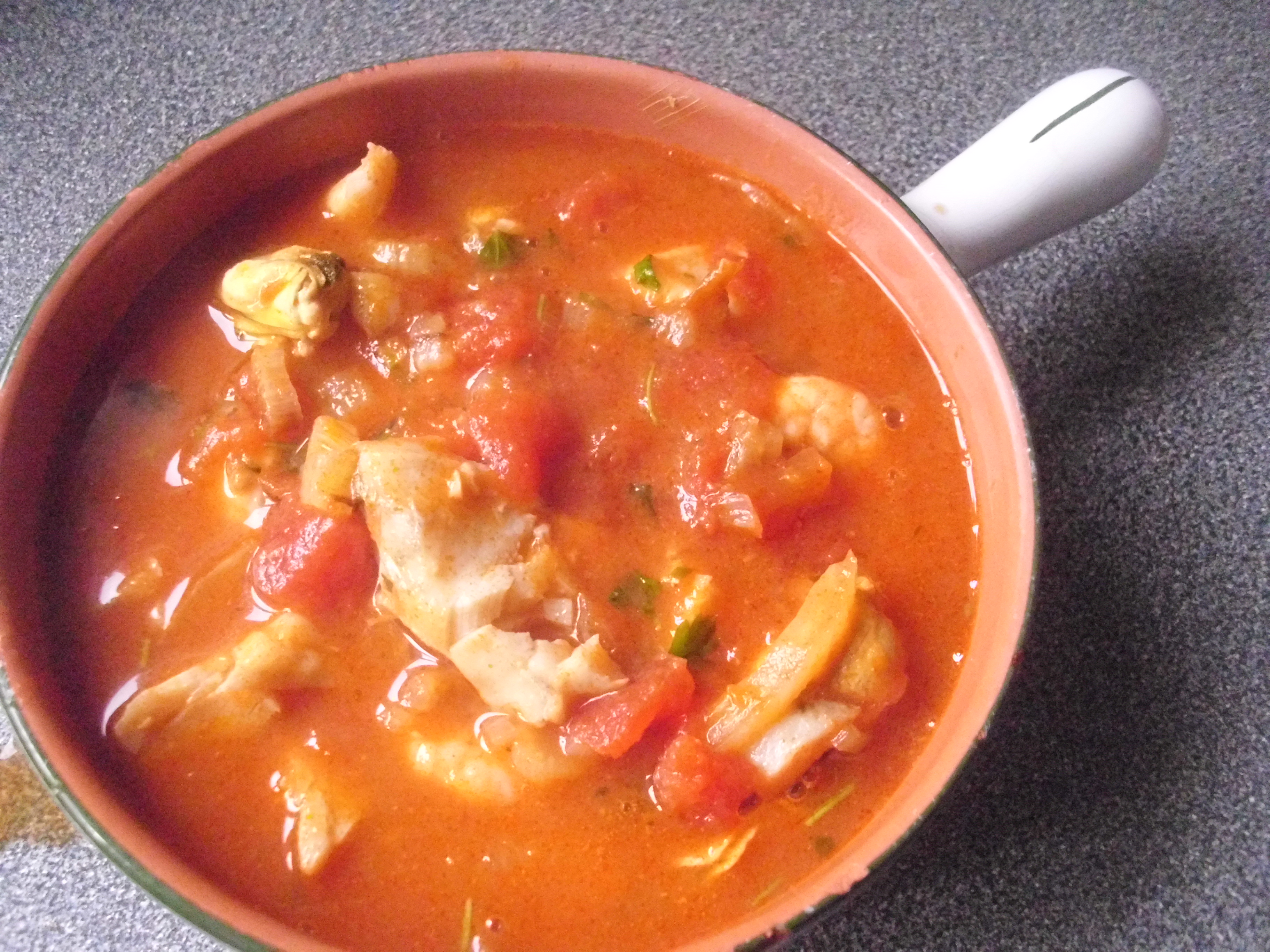
Sausage and pasta – what’s not to love?

6 Aug

We love sausages and pasta, so when it is combined in just one pot, easy and quick to cook with hardly any washing up, then this is food heaven.  I have to say I was a bit dubious that everything would be properly cooked but I enjoyed every mouthful and all I cook hear from Terry, my husband, was something that I could only describe as a purrrrrrr!  Kids will absolutely love this dish, a perfect midweek meal.  One word of advise though, use good quality sausages.  I think cheaper versions might have too much fat and maybe make the dish oily.  The pasta used in this dish is penne so I thought I would look up a few foodie facts.

Penne (pronounced peni) is a cylinder shaped pasta.  It can be either smooth or ribbed and is designed to hold as much sauce as possible.  It was perfect for todays dish and you could actually see the sauce running through the middle of the pasta and oozing out the other end.  The name penne comes from penna, Italian for feather or quill, presumably to describe the similar action of these as writing implements. 

There are some mixed theories of the origins of pasta to Italy.  Some say it was brought to Italy by Marco Polo from China.  However, there is evidence that pasta was already eaten in Italy during Polo’s time and there is even mention of a type of lasagna in 1AD!  In more recent times, the 8th Century to be exact, pasta was introduced to Sicily by the Arabs.  It was made from a hard variety of wheat and is believed to be the origin of dried pasta.  To this day there are many Sicilian recipes that contain influences from Arabian cooking, and include raisins and spices such as cinnamon. Today there are over 350 shapes of dried pasta and Italians eat over 60 lbs of pasta per person, each year!

The recipe I am sharing today is based on one from Woman and Home Dinner Tonight.  I have adapted it to suit our taste.  Hope you enjoy it as much as we did.

Sausage and pasta one-pot         Serves 4

  • 8 good quality sausages (choose the variety you like best)
  • 6 slices pancetta (or smoked streaky bacon), roughly chopped
  • 1 onion, chopped
  • 250g (9oz)chestnut mushrooms, sliced
  • 2 tbsp vegetable oil
  • 400g tin chopped tomatoes
  • 1.5 pints (about 700 ml) ham stock (made with 2 ham stock cubes)
  • 250g (9oz) dried penne pasta
  • 200g (7oz) runner beans, thinly sliced
  • 2 tsp Worcestershire sauce
  • Salt and Pepper
  1. Heat the oil in a very large, deep, frying pan or saute pan.  Fry the sausages, pancetta and onion over a medium heat for about 5 minutes until the sausage is brown all over.  Keep turning and moving around the pan to avoid burning.
  2. Add the mushrooms and fry for a further 2 minutes until they have softened slightly.
  3. Pour in the tomatoes, Worcestershire sauce and stock then add the pasta and beans.  Season then mix well, bring to the boil, then simmer for about 30 minutes until the sausages are cooked and the pasta is tender.  This should give you a rich sauce.  If the sauce is too thick simply add a little more water.  If it is too thin boil rapidly for a couple of minutes to thicken it.
  4. Check seasoning and serve immediately.

Serve with a couple of glasses of red wine! Heaven!!!!! 

This slideshow requires JavaScript.

Courgettes with pasta, my favourite pasta dish!

6 Jun

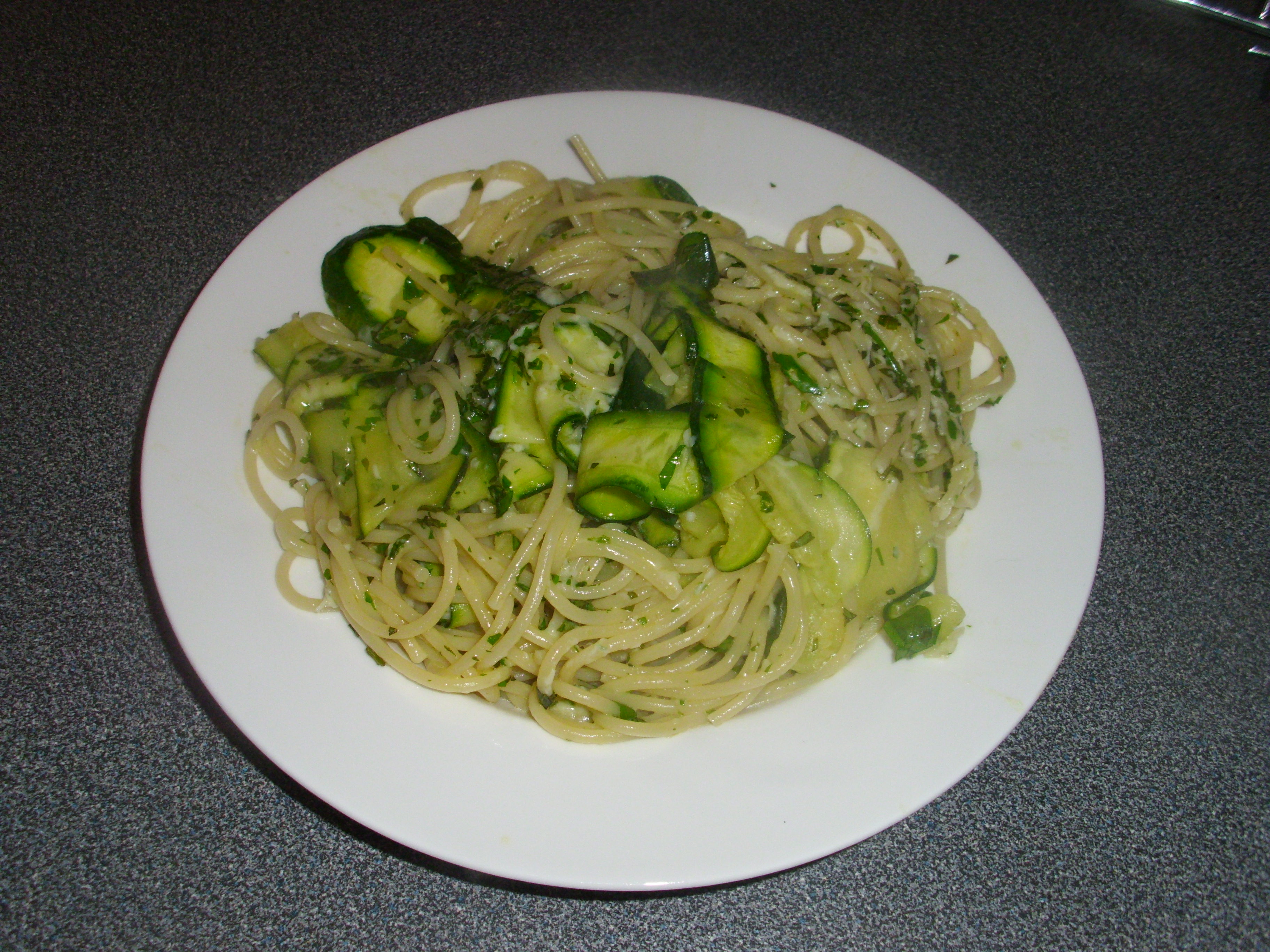
 There was a time when I hated courgettes but, over the years and after trying so many delicious recipes, that has all changed.  I love it when there is a glut of courgettes in the shops but, thankfully, you can now buy them all year round.  When we had this recently it reminded me how much we love it, and how long it had been since we ate it!  I can’t remember when we first had this dish, it must be at least five years ago.  I think our first time was because someone had given us a bag full of courgettes, they were not a vegetable I would have actually bought in those days!  The recipe would probably have come from one of the cooking journals I subscribe to and, if I remember, the picture did not look that tantalising.  I am so glad we tried it though.  Sometimes you come across a recipe that you want to make time and time again.  This is one of those times! We absolutely love this pasta dish.  You would not believe how fresh it tastes or how much flavour it packs in.  Before the recipe though, I thought I would look at some food trivia on Parmesan Cheese.

I can remember, many years ago, buying Parmesan cheese already grated and served in little tubs.  It was disgusting and smelled of sweaty socks.  Yuk!!!  The first time I bought fresh Parmesan I could not believe the flavour.  It is so strong, absolutely beautiful.  It really makes you wonder how they manage to transform such a great taste to an imitation of sweaty socks!!  A lot of people will not buy the fresh cheese as it is expensive and they may only use it occasionally.  Believe me, it is worth the expense!  I grate the whole block at a time and freeze it in a well sealed freezer bag.  That way I can take out just as much as I need when I need it.  I even freeze the rind, it gives a great flavour to soups!

Parmesan cheese is the French name given to Parmigiano-Reggiano, and one that most of the UK have adopted.  Parmigiano-Reggiano is a hard, granular cheese that is cooked but not pressed, and is produced in Italy.  The name is protected under European Law and can only be given to the cheese produced in specified regions of Italy.  Informally it is often called the ‘King of Cheese’.  The cheese is made out of cows milk and any left over whey is used to feed the pigs from which Parma Ham was produced.  Great bit of recycling!!!  The cheese is as pure and organic as possible.  Cows can only feed on grass or hay, giving grass-fed milk, and only natural whey culture is allowed as a starter.  The only additive allowed is salt which the cheese absorbs while being submerged in huge vats of brine made from Mediterranean sea salt, before being left to age for an average of two years.  The end result is a fantastic cheese with a deep, savoury flavour.  It is very strong so, although expensive, you only need a small amount yet still get the full flavour coming through.

Anyway, I’ve tried to trace the recipe to a website and failed so I have written it out for you below.  I really hope you give it a try, I am sure you will not be disappointed.

Courgettes with pasta and herbs.    Serves 4       About 530 calories

  • 12 oz/350g  spaghetti or linguini
  • 4 tbsp olive oil
  • 2 garlic cloves, finely chopped
  • 650g/1lb 7oz courgettes, cut into thin ribbons (a vegetable peeler is great for this)
  • 25g/1oz butter cut into pieces
  • 50g/2oz freshly grated parmigiano-Reggiano (or Grand Padano if you can’t get it)
  • Handful each of chopped fresh basil and flat leaf parsley
  1. Cook the pasta as per packet instructions.
  2. Meanwhile, heat the olive oil in a large frying pan or wok.  Add the garlic and cook gently for a few seconds until it becomes fragrant.  Be careful not to let it burn or it will be bitter.  Tip in the courgettes, stir to coat in the garlic oil then cook gently for about 4 minutes.  They need to be softened but not soggy.
  3. Drain the pasta and add to the courgettes, along with the butter, cheese and herbs.  Toss them gently until the butter has melted, the spaghetti is coated with the cheese and herbs and the courgettes are evenly distributed.  Season to taste and serve immediately.  You can drizzle with a little extra olive oil if you like.

    This slideshow requires JavaScript.

Thai style beef and mango salad, one of our favourite meals!

2 Jun

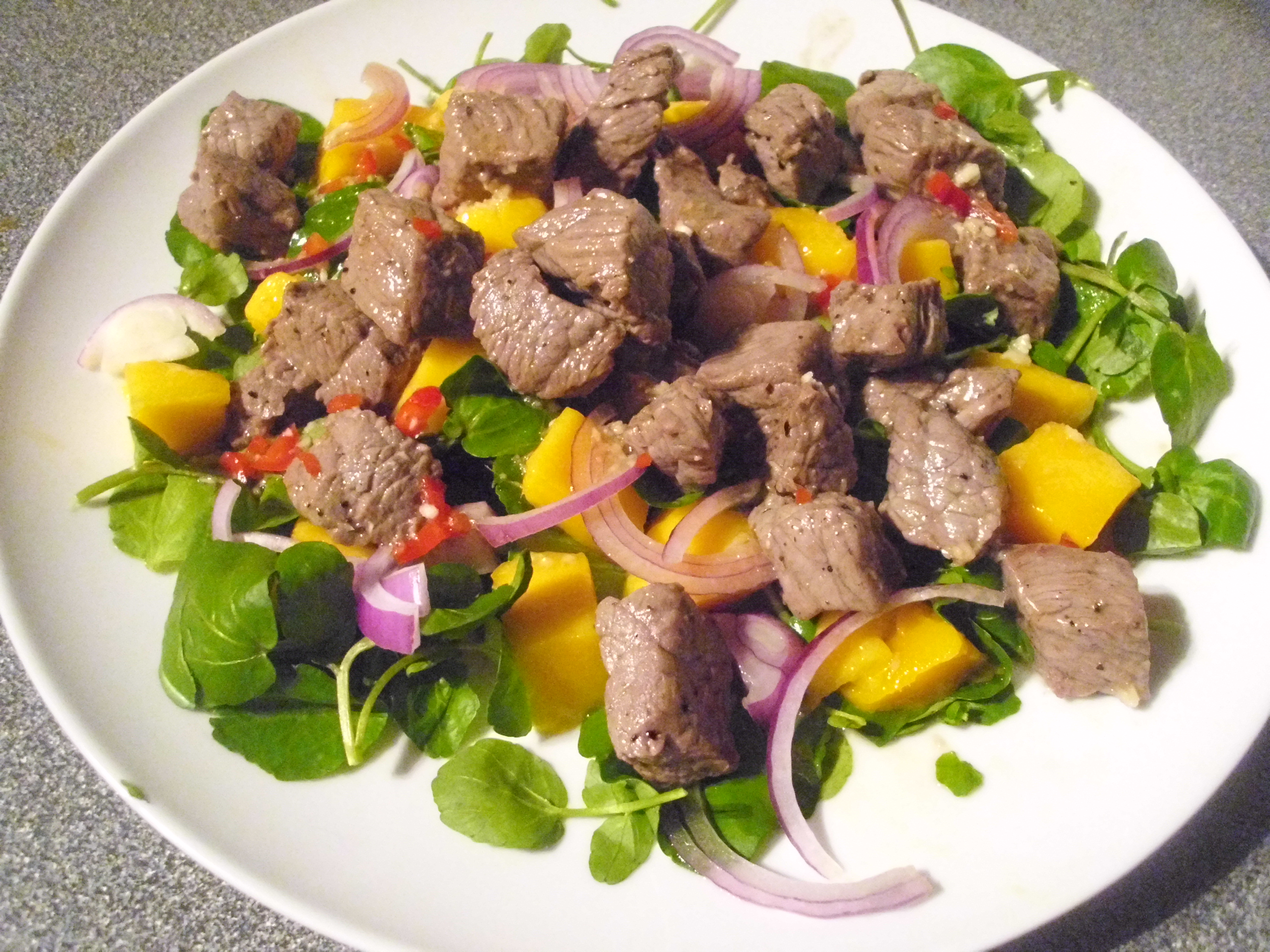
 We first had this salad about eleven years ago, shortly after we returned from living in America.  It has been a firm favourite ever since and we eat it at least once a month and more often if I think about making it.  Although this is classed as a salad it could not be further away from what I grew up to understand salads to be, i.e. lettuce, tomatoes and cucumber!  The tender chunks of beef, straight from the pan, absorb the hot and spicy salad dressing.  The sweetness of the mango is in perfect contrast with the beef and the heat from the red onion and the watercress.  Your senses will rarely be subjected to such an attack on all levels, smell, taste and sight!  Absolutely delicious and very low in fat, carbohydrate and calories so excellent for anyone who is hoping to lose weight.  What more could you ask for?

Thai food is known for its balance of the four fundamental taste senses, sour, sweet, salty and bitter.  It is often spicy as well.  This dish is an excellent example of how this balance is achieved.  Don’t be put off by the ingredients, especially the mango in a savoury dish.  If you like spicy food I think you will love this.

Thai style beef and mango salad    Serves 2 (generously)

  • 2 sirloin steaks, trimmed of fat, cut into 1 inch cubes
  • 1 mango, peeled and cut into cubes
  • 1 red onion, cut in half and thinly sliced into half-moon shapes
  • 1 bag watercress
  • 3 tsp fish sauce
  • freshly ground pepper
  • juice 1 lime
  • small knob fresh ginger, peeled and finely chopped
  • 1 garlic clove, crushed
  • 1 small red chilli, deseeded and finely chopped
  • 1 tbsp soft brown sugar
  • 1tsp sunflower oil
  1. Put the cubes of steak in a dish, add 1 tsp fish sauce and season well with freshly ground pepper.  Mix well and set aside.
  2. Divide the watercress between two plates.  Sprinkle the mango cubes and sliced onion over each plate.
  3. In a small bowl, mix together the lime juice, brown sugar, ginger, garlic and chilli.  Check for taste.  If it is too sweet add more lime, too sour, add a little more sugar.
  4. Just before serving, heat the oil in a wok.  When hot stir fry the steak , turning frequently, until it is browned all over.
  5. Divide the steak between the two plates of salad and dress, to your liking, with the dressing.  Serve immediately. 

    This slideshow requires JavaScript.

Fish Pie, yum yum!

2 Jun

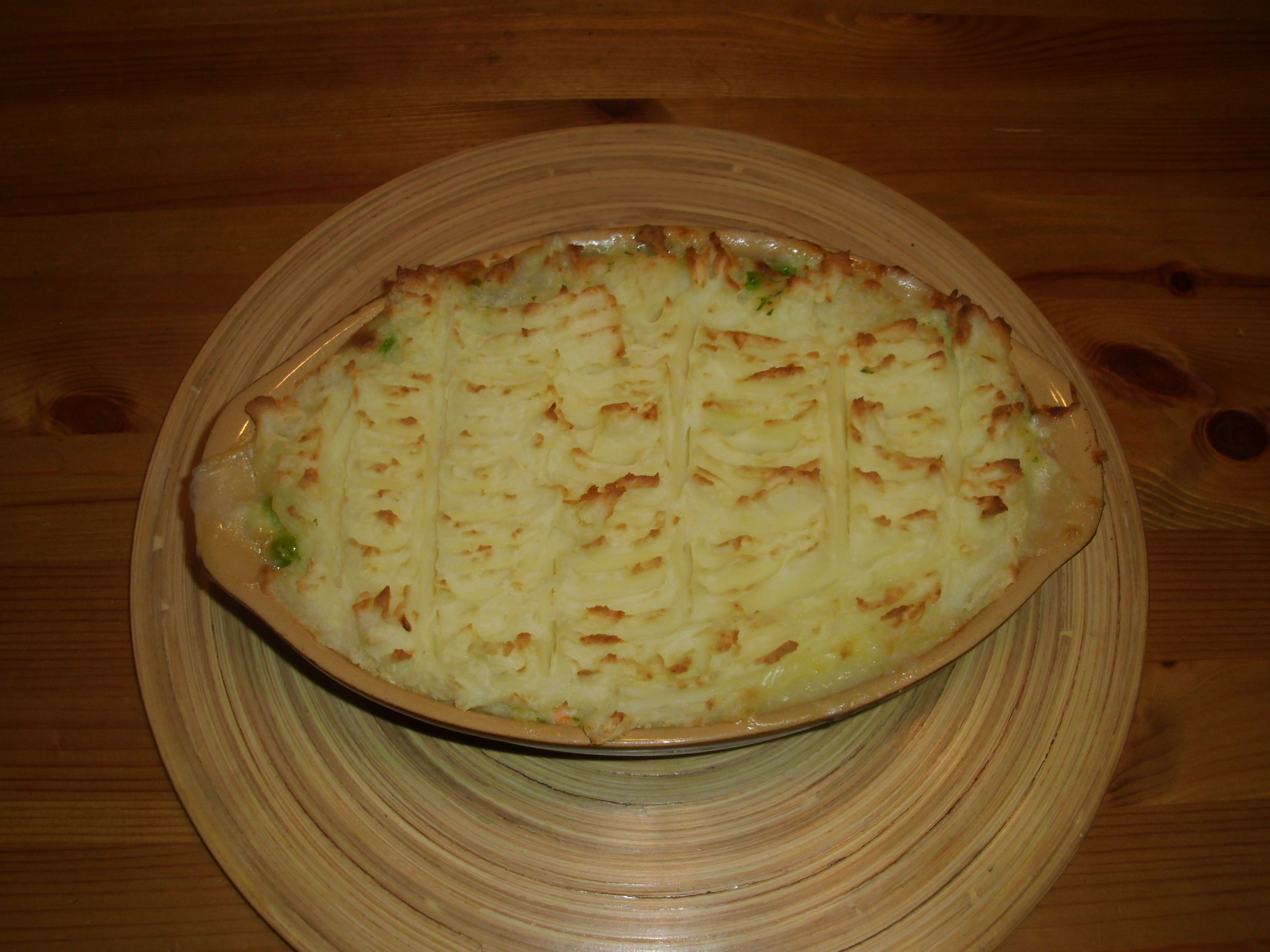
 There are all sorts of fish pie and I have tried loads of recipes but I still prefer the one I have been making for years.  It isn’t complicated and does not contain a lot of fat, it’s just great comfort food.  I can always tell when a recipe is good as there is silence around the table when people are eating, broken with the occasional mmmm!  Last night, when we had this, was just such an occasion.  The best thing about this pie is you don’t need to get hung up on the contents.  Last night I make it with cod, salmon and prawns.  I never put boiled eggs in as some of my friends hate them and, I have to say, I struggle a bit when they are in a fish pie.  Some people don’t like prawns so if I am feeding them, I simply substitute the prawns with smoked haddock.  This works really well and gives the pie a great smoky flavour.

I thought todays food trivia could be about cod.  Cod is a really popular fish with dense white flesh and a mild flavour.  The livers are processed to make cod liver oil, an excellent source of vitamins A, D and E and omega 3 fatty acids.  I remember my Mum making me take cod liver oil tablets in the winter when I was a child.  I hated them, firstly because I couldn’t swallow them and, secondly because they repeated on me and left a foul taste in my mouth.  In the UK, cod is the main fish used in the traditional Fish and Chips, along with haddock, but due to popularity, cod is currently at risk of being over fished in the UK, Canada and most other Atlantic countries.  This has caused controversy dating back to 1990, since when various committees and Government Departments have tried to restrict the fishing of cod.  Thankfully, we are still able to buy it but it is now much more expensive than when I first made this fish pie.

Anyway, here is the recipe.  It is a meal in one so there is no need to add more vegetables when you serve it, unless you want to of course.

Fish Pie                                 Serves 4 (easily halved or doubled)

  • 250g/10oz white fish fillets (cod or haddock are best), skinned, checked for bones and cut into 2 inch pieces
  • 125g/5oz fresh salmon fillets, skinned, checked for bones and cut into 2 inch pieces
  • 125g/5oz smoked haddock, skinned, checked for bones and cut into 2 inch pieces
  • About 12 raw king prawns, all shell removed
  • 750ml/1.5 pts semi-skimmed milk
  • 50g/2oz unsalted butter
  • 50g/2oz plain flour
  • 1 onion, peeled and studded with 3-4 cloves
  • 3 tbsp chopped fresh parsley
  • 100g/4oz frozen peas

For the mashed potato topping

  • 1kg/2lbs potatoes (ones good for mashing)
  • knob of butter
  • a little milk
  1. Heat the oven to 200c/190c fan/gas 6.
  2. Cook the potatoes in salted water until tender.  Drain and mash down.  Add the butter and enough milk to make a soft but firm mash
  3. Put the studded onion and the milk in a pan, slowly bring to a simmer.  Continue to simmer for about 15 minutes.  Make sure the milk does not burn on the bottom of the pan as this will give it a bitter taste.
  4. Remove the milk from the heat, discard the onion and leave the milk to cool a little.
  5. In a separate pan, melt the butter then stir in the flour.  Cook over a low heat for a minute.  Slowly add the milk, stirring between each addition to prevent curdling.  When all the milk has been added bring slowly to a simmer, stirring, and cook until the sauce is thick and smooth.
  6. Add the fish and prawns to the sauce and simmer over a low heat for 5 minutes.  Gently stir in the chopped parsley and the peas, taking care not to break up the fish, and continue to cook for 1 more minute.
  7. Tip the fish and sauce into the bottom of an ovenproof dish.
  8. Top the fish sauce with the mashed potato then cook in the oven for about 25 minutes or until the top is browning and the sauce is bubbling underneath.
  9. Serve, but be careful, it will be very hot!

    This slideshow requires JavaScript.

Beef Stifatho, a fantastic Greek casserole!

1 Jun

  I remember the first time I ate this dish.  It was in Aegina, a small island not far from the Greek Mainland and the port of Piraeus.  I was in the company of good friends, the wine flowed and I ended up singing with a group of four Greeks, none of whom spoke English.  The owner of the restaurant, Costas,  gave up at 2 am, brought us a final jug of Retsina, turned off all the lights and left us to it.  What a great memory!

Stifatho is a rich casserole of braised meat, and varies from one Greek island to another, and probably one household to another!  Some prefer rabbit in the casserole but I prefer beef.  It’s not that I don’t like rabbit but the tiny bones can be a bit fiddley.  The recipe I love best is one I found in a book written by Pamela Westland, ‘A Taste of the Greek Islands’.  If you ever get the chance to read it you will love it. 

Costas serves his Stefatho with Krithiraki, a rice shaped pasta, sometimes known as orzo.  Whenever I have cooked this I do exactly the same.  My kids love it and I never have to worry about leftovers.  You can buy it in most large Supermarkets.  The recipe is absolutely perfect for dinner parties, especially served with the krithiraki, as most people will never have had it and, those that have, will relish the memories it brings back of sun-kissed beaches, golden sunsets and friendly Greek people.  It can be prepared ahead and reheats well, it can also be frozen. Perfect for busy people! 

First a bit about the island of Aegina.  Aegina is part of the Saronic Islands, alongside Hydra, Spetses and Poros.  It is a beautiful island, very fertile and green and full of pine and olive trees, pretty villages and lovely beaches.  For those interested, there are also archaeological monuments, such as the Temple of Aphaia.  Aegina is probably best known, however, for pistachio nuts.  They have been grown on the island for as long as records existed and, today, you can buy them prepared in so many ways, roasted and salted in shells, packed into jars of local honey, covered in caramel to make a nut brittle and in their local nougat, just to name but a few.  The island is only small and it is possible to see it all in one day if you hire a car.  If ever I was tempted to live abroad it would be a tough decision as to whether to go to Aegina or Lardos in Rhodes.  For now I am happy to visit all my friends as often as possible and recreate wonderful Greek dishes such as this one.

Beef Stifatho (Braised beef casserole)  Serves 4 – 6

  • 6 tbsp olive oil
  • 1kg (about 2 lbs) braising steak
  • 2 small onions, finely sliced
  • 3 cloves garlic, finely chopped
  • 4 tbsp tomato puree
  • 200 ml (6 fl oz) red wine
  • 3 tbsp red wine vinegar
  • 2tsp sugar
  • 1/2 tsp cloves
  • 1/2 tsp cumin seeds
  • 2 bay leaves
  • 2 inch cinnamon stick
  • salt and black pepper
  • 450g (1 lb) shallots
  • 1 tbsp lemon juice
  • 2 tbsp chopped parsley
  1. Set the oven to 170C/150C fan/gas 3.
  2. Heat half the oil in a flameproof casserole and fry the meat over a high heat, stirring, until it is browned all over.  Don’t overfill the pan or the beef will steam rather than sear.  Do it in batches if necessary, depending on the size of the pan.  Remove the meat with a slotted spoon and set aside.
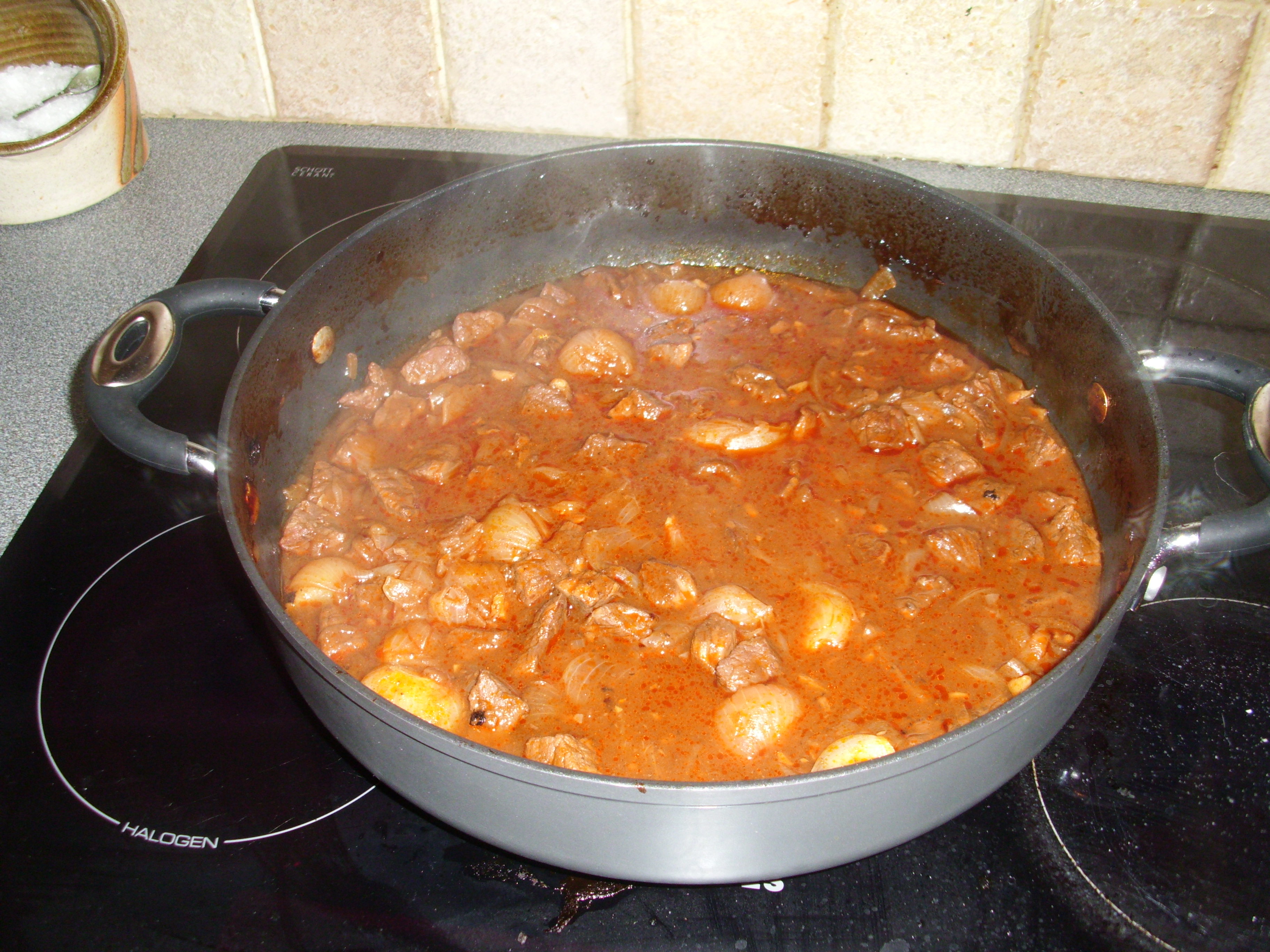
  3. Heat the remaining oil and fry the onions over a medium heat, stirring, until lightly browned.  Add the garlic and fry for a couple of minutes then add the tomato puree, vinegar, red wine and sugar.  Return the meat to the pan and mix well.  Put the cloves and cumin seeds either in a muslim cloth or a closed tea strainer.  Add to the dish with the cinnamon stick and bay leaves.  Season, cover and cook in oven for 1.5 hours.
  4. Blanch the shallots in boiling salted water for 1 minute.  Add to the casserole and continue to cook for 1 hour.  Check every now and again to ensure it is not going dry, if so, add a little water.
  5. When meat is tender, remove from oven.  Remove spices and bay leaves.  Stir in the lemon juice and sprinkle with the chopped parsley before serving.

    This slideshow requires JavaScript.

This can be made in a slow cooker. Add to slow cooker after steps 1 & 2. Cook on low for 6 hrs or high for 3 hours. Add the blanched shallots and continue cooking for 2 hrs on low or 1 on high. Check the shallots are tender then complete Step 5 before serving. Kali Orexi.

Moussaka

28 Aug


Moussaka is recognised as the traditional dish of Greece. I have many happy memories of our times in Greece, sitting in the sunshine looking out over turquoise blue seas, eating this with a Greek Salad on the side and maybe a glass or two of Retsina. If you were lucky the Retsina would be served in a bottle, chilled, but in our early visits there were no such luxuries and it would be decanted from huge barrels into a copper jug. It’s a bit like Marmite, you either love it or hate it and some think it tastes like turpentine. I absolutely love it and have a copper jug at home that I decant the bottle into for authenticity. If I close my eyes I am transported back to those idyllic shores with my first sip of wine.

The traditional recipe for Moussaka will include frying the aubergines. I have adapted this recipe so that it is lower in fat but retains the authentic flavours. The traditional cheese would be kefalotyri but f you can’t find this Parmesan or Gruyère would be a good substitute. I have also added very thinly sliced potatoes and courgettes, personal choice so optional.

Moussaka.            Serves 6

  • 2 large aubergines, sliced into rings about 1/2 inch thick
  • 500g beef mince (5% fat)
  • 3 tbsp vegetable oil
  • 1 large onion, finely sliced
  • 150 ml dry white wine
  • 12 oz (340g) fresh tomatoes, thinly sliced
  • 2 small courgettes ( topped and tailed then thinly sliced)
  • 1/2 tsp ground cinnamon
  • 1/4 tsp ground allspice (optional)
  • Salt and pepper
  • 1 tsp dried oregano
  • 2oz (50g) grated kefalotyri (or Parmesan or Gruyère)
  • Small handful chopped parsley
  • 4 small waxy potatoes (I used charlottes) peeled and thinly sliced
  • 3 oz (85g) butter
  • 3 oz (85g) plain flour
  • 1 pint (600g) milk
  • 2 eggs yolks beaten
  • 35g low-fat cheddar, grated
  • Extra 2oz (55g) cheese for topping

1. Bring a large pan of salted water to the boil then blanch the aubergine slices in batches for 5 minutes. Remove and place in a single layer onto kitchen paper to drain. Discard water.
2. In another large pan, sauté the onion in the oil until softened but not browned. Add beef and continue cooking over low heat until browned and no lumps about 10 minutes.
3. Add wine, tomatoes, courgettes, cinnamon, allspice, oregano and seasoning. Mix well. Cover and cook over low heat for about 20 minutes, adding a little water if it is going dry. Remove cover and cook for 15 minutes more to allow excess water to evaporate. You are aiming for a thick meat sauce. Mix in the kefalotyri and parsley Remove from heat and allow to cool slightly.
4. In an ovenproof dish put a layer of the potatoes followed by a single layer of the aubergine (doesn’t need to be totally covered), followed by a layer of meat sauce. Repeat with aubergines and finish with a final layer of meat sauce.
5. In a saucepan make the bechamel sauce. Melt the butter over a low heat and beat in the flour until combined. Slowly add the milk, beating well before each addition to prevent lumps. Stir continuously until the sauce thickens. Remove from the heat and carefully add the eggs yolks cheese. Mix well then pour over top of the meat until completely and evenly covered. Sprinkle with extra cheese then bake in preheated oven (180C/170C fan/Gas 4) for 1 hour until the top is golden and base heated through.
6. Remove from oven and allow to stand for about 10 minutes so the top firms up. Serve with a mixed salad if you like.


Samosa Chaat

21 Aug

Chaat or chat is a family of savoury snacks that originated in India, typically served at the roadside from stalls or food carts across the Indian subcontinent in India, Pakistan, Nepal and Bangladesh. There are many variations. The recipe below is using samosas as a base but my friend Monica has given me another recipe that has potato patties as a base. It sounds delicious and, when I have made it, I will add the recipe to my blog so you can all enjoy it.

Chickpea Curry Serves 2 hungry people

  • 4 tablespoons vegetable oil
  • ¾ teaspoon cumin seeds
  • 1 medium onion, finely chopped
  • ¾ tablespoon ginger and garlic paste
  • 1 birds eye green chilli, finely chopped
  • 200g can chopped tomatoes, pureed
  • ¾ teaspoon turmeric powder
  • ½ teaspoon red chilli powder
  • ¾ teaspoon cumin powder
  • 20g butter
  • ¾ teaspoon of salt to taste
  • 250g chickpeas from a tin, drained
  • 80ml water
  • ¾ teaspoon pomegranate molasses
  • ¼ teaspoon raw mango powder
  • 2 tablespoons fresh chopped coriander
  • ¾ teaspoons garam masala
  1. Heat the oil in a saucepan and then add the cumin seeds and sizzle for about thirty seconds
  2. Then add the chopped onions to the saucepan and cook until the onions are golden brown, this should take about 5-7 minutes on a medium heat
  3. When the onions are golden brown, add the ginger and garlic paste and green chilli to the onions and cook for about a minute
  4. Add blended plum peeled tomatoes to the saucepan together with the turmeric, red chilli powder, cumin powder, salt and butter
  5. Cover saucepan and cook masala for a good 10 minutes (stirring in-between), add water if masala starts to dry up
  6. Once masala is sizzling and the butter and oil has seeped from the edges, add drained chickpeas, mango powder and pomegranate molasses together with the water for moisture, cook for a 3-4 minutes
  7. Add final touches of garam masala and chopped coriander, cook for a final 1-2 minutes and remove from the heat.

Construct the Chaat

  • 5 Vegetable Samosas, cooked and hot
  • ½ Medium Red Onion, finely chopped
  • Chickpea curry
  • A drizzle of Tamarind sauce
  • 3 Tablespoons natural Greek Yoghurt, seasoned with 1 teaspoon cumin, ½ teaspoon salt and ¼ teaspoon black pepper
  • 2 tablespoons fresh Coriander, finely chopped
  • 1 Tablespoon Nylon Sev, optional, garnish
  1. Cut the samosas into bite sized pieces and share between 2 bowls
  2. Sprinkle over a dessert spoon full of chopped red onions
  3. Spoon over some chickpea curry
  4. Add a tablespoon of seasoned yoghurt
  5. Drizzle over tamarind sauce
  6. Garnish with coriander and a tablespoon of nylon sev
  7. Serve

Potato and aubergine Sabzi

13 Apr

This is yet another beautiful recipe shared by my friend Monica. It is one of her mother’s recipes and one of Monica’s favourites and I can see why, it is absolutely delicious.

Before I share the recipe I would like to share a very interesting article Monica wrote on basmati rice.

“The Story of Basmati Rice – The crown Jewel of Indian Cuisine, In Foreign land people try to achieve the biryani that they ate in a indian restaurant or rice dishes that they ate during their trip to India. They try to get all the possible spices to put in a biryani and yet they buy a regular Basmati Rice available in Regular Non Indian Supermarkets and fail to get the same result of each rice grain fragrant and apart in a Biryani. Also in today’s time where Brand is all what people talk about, they buy a particular branded Rice and yet fail to achieve the result.
By reading this article you will know how to choose best Basmati Rice for your home. People who like to stick to points can directly go to the bottom of article and people who like stories and culture around a food can continue to read on.
When I was a child, I accompanied my mother to grocery stores and at that time we didn’t get branded rice, dal or flours but yet we ate the best quality food. My mother would touch the grain, smell it, see the size and colour of it and would choose the best one. I am sharing the same with you all today.
A Good Basmati Rice is at minimum aged 2 years, So does it mean the older the basmati rice, the better it is. “Oh Yes” As the years pass the long grain basmati rice changes it’s colour from white to off white and the fragrance of rice increases. It also means that Basmati Rice doesn’t have any expiry date if it is well stored.
My Mom would buy a quintal of Rice, Wheat, Dals and Whole Spices and would store it well in Big Metal Drums, she used dried Neem Leaves(Its a medicinal tree with bitter leaves and stems) to prevent grains from getting any pests. Before making rice she would spread grains on a plate to check for any stones and wash it 2-3 times and then cook. It is important to wash it 2-3 times until the water is clear so when you cook the rice the grains don’t stick due to presence of starch.
Off Topic – It was also a tradition in India when a girl got married the parents gifted her metal drums and utensils to make her own kitchen in the new home, though now since big companies have started packing things in plastic and in small bags, and also we do not live in joint families anymore plus we often eat outside (when I was child until 12, we only ate out when travelling) we do not need these big drums to store our Rice and Grains, But still my mom followed the tradition (knowing I am getting married to an NRI and I can never take those drums and utensils with me to Spain) she bought me those drums, filled it with homemade sweets and papad for my Husband’s entire family and also for distribution. (Well In India you can’t stop your parents or family to do anything in your wedding, they like to fulfill all their dreams in their daughter’s wedding)
Back to Rice – To retain the fragrance and taste we do not drain water (except in some dishes), we have ratio of water and rice (depends on the kind of basmati rice you have got, since my mother bought in bulk she would understand the ratio and apply it for the rest of the Rice) plus we add some oil or ghee and salt. I do remember from my childhood and even now when we cook a good basmati rice I can eat it just plain.
Also I find how previous generation cared for optimum use of energy sources, they were better at planning important things like meal (Not like us who would want every thing ready to use like pastes, frozen food etc) which not only fed their family better quality food but also saved expenses on cheap meals and medical bills due to malnourishment(well this is an entirely different topic, coming back to Basmati Rice) They did soak it for 30 mins before putting it to cook which saved Gas, time and also make the rice fluff up and evenly cooked. And they did the same for lentils, beans, chickpea etc.
Here are the Pointers for making a perfect Basmati Rice”

Thank you Monica!

Here is the recipe. We had it as a side dish but it would be great as a main and perfect with other small dishes to have with puri. I hope you enjoy it.

Potato and aubergine Sabzi – serves 2 as a main or 4 with other small dishes

  • 1 large, firm aubergine
  • 2 medium waxy potatoes
  • 1/2 tablespoon fennel seeds
  • 1 teaspoon turmeric
  • 2 tablespoons vegetable oil
  • Red chilli powder to taste

1. Cut the aubergine and potatoes into small cubes, about 1/2 inch

2. Put some vegetable oil, about 2 tbsp, into a pan and add 1/2 tbsp of fennel and 1 tsp turmeric. Make sure the seeds don’t burn. When it start to smell fragrant add the vegetables and mix well to cover with the spices.

3. Cover and on the lowest heat cook gently until the potatoes are tender and the aubergine is soft and creamy. Check on it occasionally to make sure it’s not catching. It can take anything from 15 minutes to 45 minutes depending on the size and type of potatoes etc.

4. When cooked add some red chilli powder to taste 🤣🤣

Puri with potato curry.

1 Mar

Today I was privileged to be invited for breakfast at our friends house. Monica had promised me a special Asian breakfast and a one to one lesson on how to cook puris. Puri is my favourite starter when I go to an Indian Restaurant, usually topped with either prawn or chicken curry. In India, I’m told, puri is a favourite breakfast food, usually served on special occasions or for a treat maybe at the weekend. The whole experience was amazing!

One of the puri ingredients was a spice called Ajwain. I have so many herbs and spices but I had never heard of this.

Ajwain, also known as ajowan caraway, thymol seeds, bishop’s weed, or carom, is an herb in the family Apiaceae. Both the leaves and the seedlike fruit (often mistakenly called seeds) of the plant can be used.

Ajwain’s small, oval-shaped, seed-like fruits are pale brown schizocarps, which resemble the seeds of other plants in the family Apiaceae such as caraway, cumin and fennel. They have a bitter and pungent taste, with a flavor similar to anise and oregano. They smell almost exactly like thyme because they also contain thymol, but they are more aromatic and less subtle in taste, as well as being somewhat bitter and pungent. Even a small number of fruits tends to dominate the flavor of a dish so need to be used sparingly. Only a small amount was used in this recipe but the subtle flavour still came through and really enhanced the end product. If you can’t get these seeds Monica says you can substitute with a small quantity of fenugreek leaves, crushed between your hands.

Here is the recipe. (Monica used intuition rather than measurements but hopefully I’ve judged correctly).

  • Puri ingredients
  • 500g Chapati flour
  • 1 tsp salt
  • 1 tsp ajwain seeds or fenugreek leaves
  • A drizzle of oil
  • Water
  • Put flour and salt into a large bowl.
  • Rub the Ajwain or fenugreek between your hands and add to flour.
  • Drizzle with the oil
  • Loosely mix together.
  • Start adding the water, scrunching everything together with one hand, until it forms a dough. The dough needs to be hard not soft or wet.
  • Break of pieces of dough and make into balls.
  • Lightly oil each ball on both sides to prevent sticking and roll out into round discs about 3 inches in diameter and the thickness of a pound coin.
  • Heat up some oil in a pan. When hot enough to deep fry carefully drop in one puri at a time. Allow it to rise to the top of the oil and puff up. Turn over. When lightly coloured remove and drain on kitchen paper. Continue until all are cooked, keeping them covered to keep warm. Serve with the Aloo bhaji and chutneys of your choice.
  • Aloo Bhaji ingredients
  • 2tbsp oil
  • 3 large potatoes, diced about 1/2 pieces
  • 3 large tomatoes, puréed and sieved to remove seeds
  • 1 fresh green chilli roughly chopped
  • Handful of chopped coriander
  • 1 tsp cumin seeds
  • 1 tsp turmeric
  • 1/2 tsp red chilli powder
  • 1 tbsp coriander powder
  • Heat the oil and cook cumin seeds until they start to splutter. Be careful not to let them burn.
  • Add the sieved tomato purée and all the powdered spices.
  • Simmer until the oil separates and the tomatoes are cooked well.
  • Add the potatoes and coat well in tomato mix and cook for a couple of minutes.
  • Add enough water to just cover the potatoes and cook until the potatoes are soft and mushy. Add a little more water if it looks as though it’s getting too dry.
  • Add the chopped coriander, simmer for a couple of minutes. Check seasoning(to taste) and it’s ready to serve.

Chicken and mushroom casserole

6 Nov

imageThis was one of the first dishes I made when I started going to Slimming World.  I joined because I love their attitude to food  I don’t think I ever thought about the amount of fat I was using in recipes.  They say that is what gives the food flavour but time after time I have proved that to be wrong.  Nowadays I only ever use spray oil sparingly and the food still tastes wonderful.  By my calculations this works out at just 3 Syns per person but please check this is right.  This will not make any sense to those not on slimming world but suffice it to say it is very low fat and healthy. Here is the recipe.

Chicken and mushroom casserole        Serves 4

  • Fry light oil spray
  • 100g lean back bacon, all fat removed and cut into strips
  • 2 medium onions thinly sliced
  • 8 chicken thighs, skinned
  • 2 cloves garlic, crushed
  • 1 tbsp seasoned flour
  • 2 tbsp brandy
  • 200g mushrooms, sliced
  • 125 ml white wine
  • 400 ml chicken stock (made with 2 organic stock cubes)
  • 2 tbsp chopped fresh parsley
  • 2 sprigs fresh thyme
  • salt and pepper
  1. Spray a large non-stick skillet with oil. Fry the onions and bacon over a medium heat until the onions are tender. Remove and set aside.
  2. Spray a little more oil into the pan and fry the chicken in batches until brown on all sides.
  3. Return the onion and bacon to the pan with the garlic, flour and brandy. Stir and cook for 1 – 2 minutes.
  4. Add the mushrooms, wine, stock, herbs and seasoning, stir well and bring to the boil. Reduce the heat to low, cover and simmer gently for 45 minutes or until the chicken is cooked through.
  5. Check the seasoning and serve with potatoes and vegetables of your choice.


This slideshow requires JavaScript.